
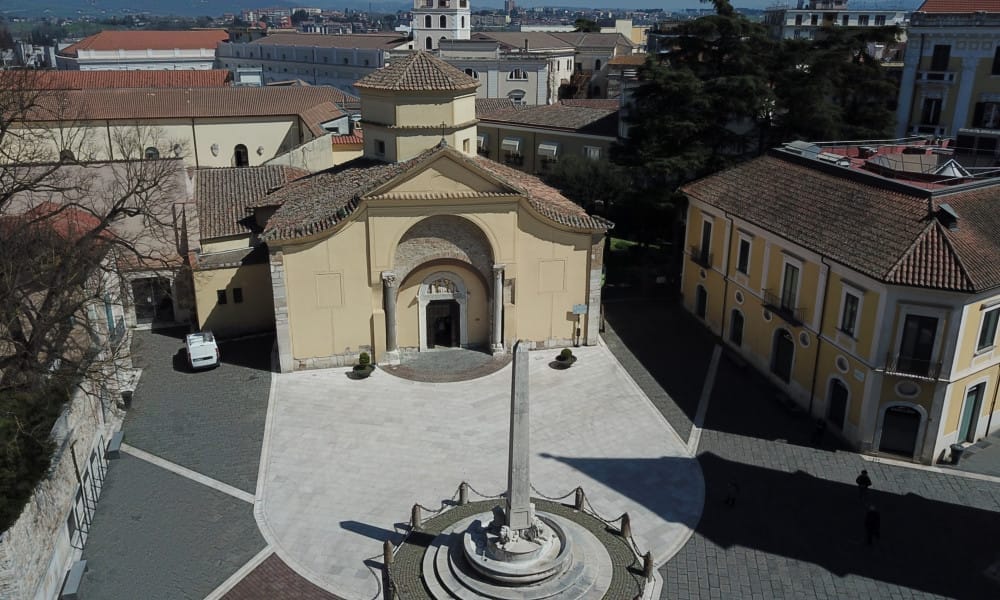
In 774 AD, when Charlemagne conquered the Lombard kingdom of Italy, the Duchy of Benevento alone held out — and would continue to do so for another three centuries, becoming the last independent Lombard state in Italy. This remarkable history left an indelible mark on Sannio, and nowhere is that mark more visible than in the Church of Santa Sofia.
Built between 760 and 774 AD by the Lombard Duke Arechis II, Santa Sofia is a geometric marvel: a centrally planned space of extraordinary refinement, with a hexagonal colonnade supporting an octagonal drum that opens into the main apse. The form reflects both the architectural ambitions of Lombard Benevento and the influence of Ravenna and Constantinople, reflecting the duchy's position at the crossroads of the Byzantine and Carolingian worlds.
In 2011, Santa Sofia became part of the UNESCO World Heritage designation for the "Longobards in Italy: Places of Power," sharing the honor with six other sites across Italy including the complex at Cividale del Friuli, the Lombard basilicas of Brescia, and the monastery of San Salvatore/Santa Giulia.
Beyond Santa Sofia, Benevento's Longobard heritage includes numerous fragments and artifacts preserved in the remarkable Museo del Sannio, whose Romanesque cloister is one of the finest in Southern Italy. The Arco di Traiano, though Roman rather than Lombard, adds another layer to the city's extraordinary historical palimpsest.
For cultural tourists seeking authentic experiences beyond the crowded circuits of Rome, Florence, and Venice, Benevento and the Sannio region offer a genuinely exceptional alternative.